01
What it actually is
Including why the military specified it that way, which is usually the reason it outlasts the $400 version.
The surplus trade prices by condition and almost nobody says the condition out loud. That one missing word is why you cannot tell whether the sticker in front of you is a deal or a mugging. This book puts the word back.
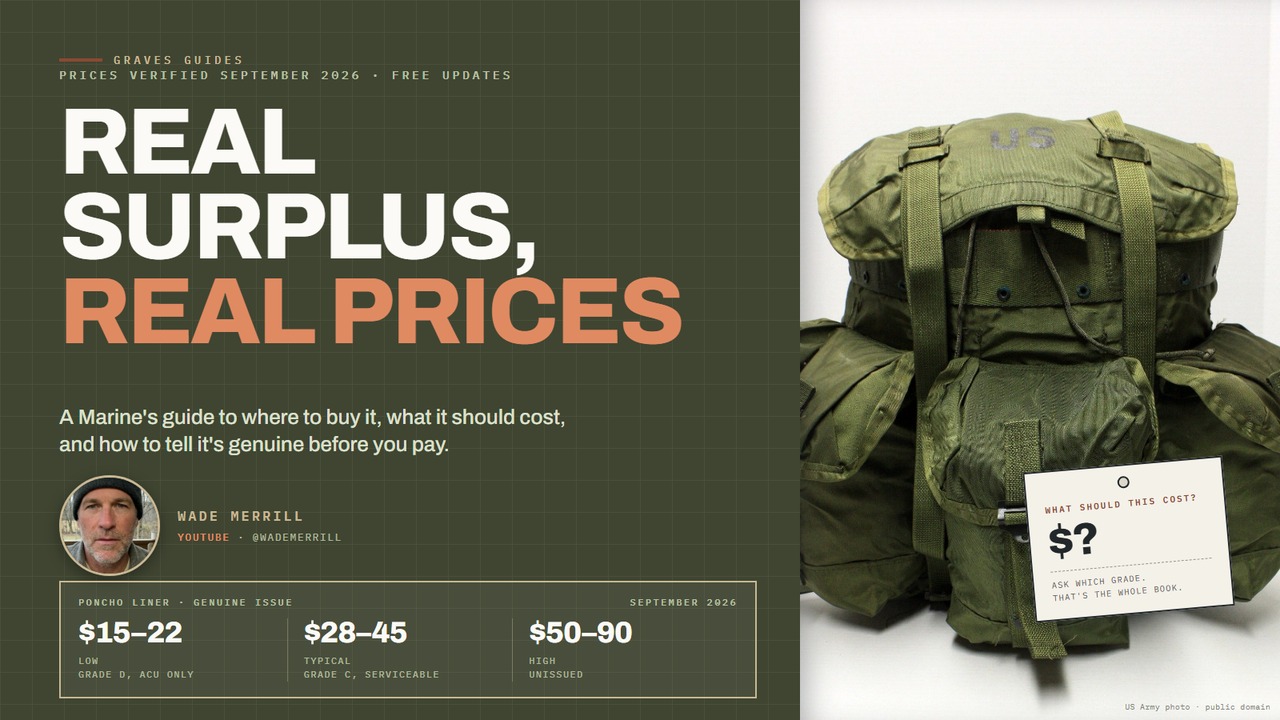
There is no shortage of people who will show you the gear. Ten-minute tours of a surplus store, twelve items you should own, a rack of old wool. Then the video ends and you are standing in a warehouse in an industrial park holding a bag with a number on it and no idea whether that number is fair.
The reason the argument never settles is that six sellers run six incompatible grade scales and not one of them publishes a percentage of new. So one person paid $18 and one person paid $52 for what they both call "a woobie", and they are both telling the truth, and they will argue about it in a comment section forever.
Twelve chapters and three appendices. Every item entry carries the same four things in the same order, so you can work it standing up.
Including why the military specified it that way, which is usually the reason it outlasts the $400 version.
Ranked sourcing channels with the stores named. Six channels compared on price, shipping, and how honest each one is about grading.
Low, typical and high, each one naming the condition grade it assumes, stamped to the month it was pulled.
One line, drawn out, doable in the aisle in seconds. Cross-referenced to the five-check chapter if you want the long version.
National stock numbers you can look up for free in about ten seconds. Named contract and specification designations. Stores with addresses. Price bands dated to the month. The last appendix exists purely to teach you the tools, because a guide you cannot check is just a guy talking.
Where something could not be verified, the book says so on its face. One chapter prints a verified stock number for a cord and then openly explains why it did not print the number the seller was using. That is the standard the whole thing is held to.
Illustrated throughout with public-domain US government photography and hand-drawn diagrams of the physical tells: stamp locations, weave sections, stitch patterns, buckle geometry. There is no AI-generated gear photography anywhere in this book, because a book whose promise is "this is what the real one looks like" cannot illustrate itself with a machine that invents stitching.

That is the only credential I am claiming, and it is the one that matters here. It is why I know what the stuff is supposed to feel like in your hands, which seams give out, which hardware is cast and which is stamped, and roughly what any of it is worth when somebody is selling it back to you at a markup.
I also got a price wrong on camera once, in front of a lot of people, and this book corrects it in the first chapter. The $18 number is the patient buyer's floor at the bottom grade. It is not what a poncho liner costs. Correcting that is worth more to you than defending it was worth to me.
You get every updated edition free, delivered to your Gumroad library, for as long as this edition runs. That is the whole reason the dates are stamped on every band: so you can see exactly how old a number is and decide whether to trust it.
No. There is no doomsday content in it. It is a buying guide for people who want gear that works at the price it should cost.
No. It is not a collector's manual and it does not do provenance or appraisal values. It prices gear you would actually carry and use.
It is written for exactly that. The first chapters are about where the trade moved and how to read a listing before they are about anything else, and the aisle reference is designed so you can walk in cold and not look like it.
Seven days, full refund, no questions and no forms. Email and it is done.
36,460 words, 39 illustrations, every price dated and graded, and a lookup appendix so you can check every last one of them yourself.
Get the book — $27